The Game Is Rigged. You Can Still Win.
Comfort is everywhere because somebody profits from it. What I’ve found about the food we’re surrounded by, why I call it the capture and not a conspiracy, and how structure beats it when willpower doesn’t.
· 6 min read
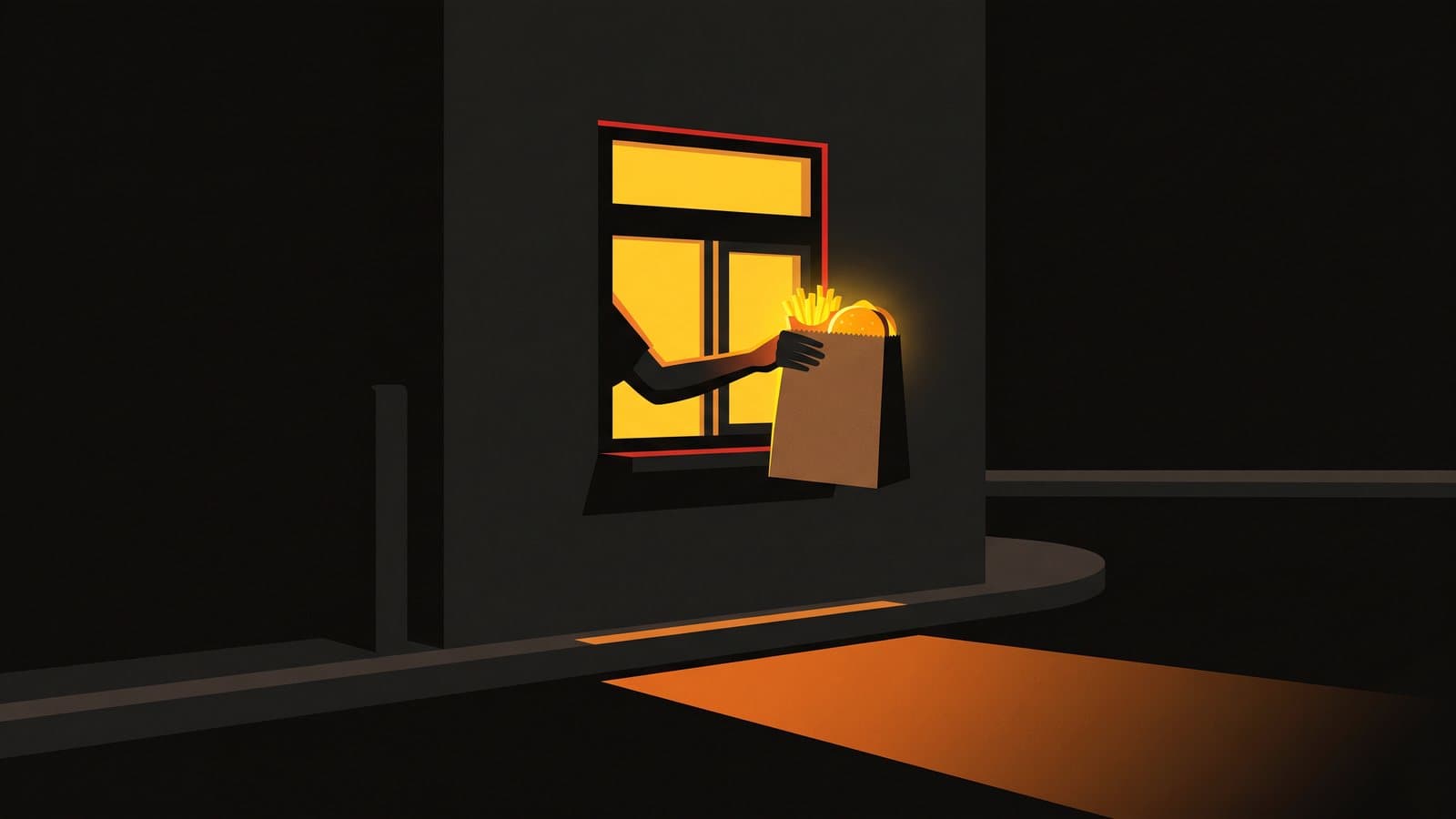
The wellness committee at my work hosted a treat day. The treat was ice cream.
A “wellness” ice cream day.
Of course I didn’t have any. I’m locked in. I politely declined the direct offers and walked past the display all day. My mindset had already shifted by then.
I added it to my log of “goofy offers”. It’s a tracker I built with AI to log offers like that. I track them out of curiosity, and because I’m a nerd by nature.
I don’t think anybody on that committee was trying to hurt anyone. That’s exactly the part I want to talk about. When even the wellness day is ice cream, the problem isn’t one person’s bad choice. It’s the default.
A thought I’ve had for years
For a long time I’ve had a half-joking line about fast food. The chains are like regional drug dealers. Same corner, same product, same customers coming back.
I said it as a joke. The longer I’ve tracked my own eating, the less it sounds like one.
This isn’t a new idea for me. It’s one I’ve carried around for years, and this is me finally putting it into words.
Sugar is the gateway. The real product is bigger.
Sugar is the easy place to start, because everybody half-knows it already. It’s hidden in things that don’t taste sweet, sold under a “fruit” label, and poured into a glass of juice we call breakfast. Starch counts too. Bread, rice, cereal and potatoes all end up as sugar in your body, even if they never taste sweet. Dr David Unwin and the Public Health Collaboration made a set of free infographics that show this in teaspoons of sugar, and once you’ve seen them, you can’t unsee them.
But sugar is only the headline. The real product is food that has been engineered so you keep eating it.
That’s not just my opinion. In a study at the US National Institutes of Health, people ate about 500 more calories a day on an ultra-processed diet than on an unprocessed one, even though both diets were matched for sugar, fat, salt and fibre on offer. The processing itself made them eat more. (Hall et al., 2019)
Some researchers go further and estimate that around one adult in seven shows signs of addiction to ultra-processed food. (Gearhardt et al., 2023)
So I don’t think the drug-dealer line is much of a stretch anymore. The dose is hidden, the product is built to bring you back, and it’s on every corner.
Capture, not conspiracy
Here’s where people usually lose me, and where I want to be careful.
I don’t think there’s a room somewhere where food companies, doctors and governments meet to keep us fat. Nobody needs to meet. The incentives line up on their own. That’s what I mean by the capture.
I see it in three places:
- Medicine. For decades the official advice pushed low fat and lots of carbs. Dr David Unwin, a UK family doctor, has talked openly about being treated as “not respectable” for getting patients off medication by changing what they eat.
- Education. Nutrition just isn’t taught. Nobody taught me. When I was younger, a very jacked guy I worked with mentioned “macros” once, and I brushed it off. Years later, in my thirties, a super-lean fellow truck driver, the guy everyone called a “health nut”, noticed I’d been losing weight. (That run didn’t last either. It became another one of the locks on my gym bag.) He asked about the oxtail and rice and peas I’d brought for lunch, and whether I knew about macros. I didn’t. Then I remembered the first guy, and I clocked the pattern: two lean guys who knew about macros, and me, not lean, who didn’t. Once I got over the dent to my ego, I taught myself.
- The public purse. When people get sick from what they eat, the cost doesn’t land on the people selling the food. It lands on all of us, through health care and lost work.
None of that needs a villain. That’s exactly what makes it hard to fight.
Comfort is the bait
This is where it connects to the thing I keep coming back to on this channel: the very abundance of comfort is one of the problems, and everybody runs towards comfort, including me.
You can see it everywhere. DoorDash and Uber Eats bring goofy food to your door. The AC in my car broke, and I couldn’t stand driving with the windows open. Working out is hard, there’s no time, it’s genetics. Every one of those is the comfortable default.
The capture is why comfort is so cheap and so close. The comfortable choice is the profitable choice, so it’s the one that’s always within reach.
It’s not your fault. It’s still your move.
When I put all of this together, two things are true at once.
The game is rigged. If you’ve struggled with food, it isn’t because you’re weak or lazy. You’ve been swimming against a current that was built on purpose. Letting go of that shame is a relief, and the shame never helped anyway.
And you can still win. Not by being tougher than the machine, but by not playing on its terms.
What I actually do
I’m not going to tell you what to do. Here’s what I’ve found works for me.
- I plan the slot, not just the meal. My slips cluster where the planned food is missing. The chocolate showed up on the days the eggs didn’t.
- I count the losses as well as the wins. For a while I only tracked the food I turned down. Then I realised that was only half the story, so now I track what I accept too. An honest record means counting both.
- I make rules after a miss, not before. One night at the movies, a large popcorn got through. Now my rule is simple: movies don’t include popcorn.
- I use my own numbers, not someone else’s plan. I started this run at 277 lb. I’m at 229 now. That didn’t come from willpower. It came from structure and from paying attention to my own data.
When it flips
Not long ago I showed up at my gym and couldn’t get in. There was a fee problem on the account, I paid it, and the door still wouldn’t open.
What I felt surprised me. I wasn’t relieved to have a free pass. I was annoyed, because I wanted to work out.
For years I went back and forth with the gym. Somewhere along the way that changed. In my own words at the time: “I have moved from trying to make myself exercise to being frustrated when something prevents me from exercising.”
The next day I trained at a new gym. Not maybe.
That’s the other side of the capture. Every system is built to keep you in something. At some point you get to choose which one keeps you in, on purpose.
The game is rigged. I’m still playing.
None of this is advice. It’s what I’ve found by doing it, one logged meal and one workout at a time. The food around us is built to keep us eating, and the people who should push back mostly don’t. It still isn’t the end of the story.
Stay sharp, keep growing.